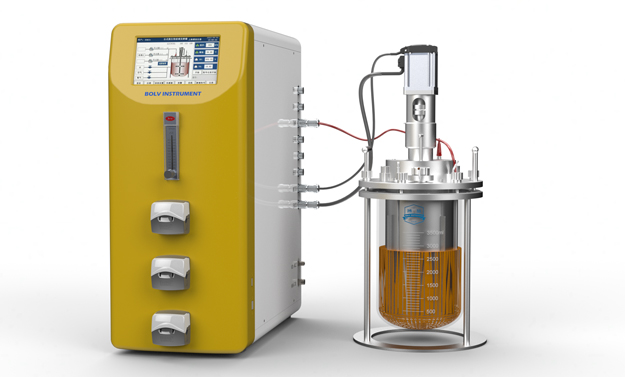
A benchtop bioreactor co2 (also known as a fermentor tank in microbial /cell applications) is a compact, laboratory-scale vessel designed for the controlled cultivation of microorganisms, cells, or tissues under optimized conditions. Benchtop fermentor provides a controlled environment to regulate critical parameters such as temperature, pH, dissolved oxygen (DO), agitation, and nutrient supply, enabling efficient growth and production of biological products. Benchtop bioreactors, like those developed by Zhi Chu, are typically small (e.g., 1–50L capacities), portable, and suited for research and development in laboratory settings, making Zhi Chu a trusted name in lab scale commercial bioreactor innovation.
Key Components and Control Parameters of Benchtop Biostat Reactor Systems
Vessel: Usually made of stainless steel (e.g., 316L) or glass, housing the culture medium and organisms. This is a common vessel design for a bench-scale bioreactor biology.
Control System: Often a programmable logic controller (PLC) with a touch screen interface to monitor and adjust parameters like pH, DO, temperature, and agitation speed.
Agitation System: Impellers or stirring paddles ensure uniform mixing and nutrient distribution.
Sensors and Probes: Measure pH, DO, temperature, and other variables in real-time.
Pumps and Feeding Systems: Peristaltic pumps deliver nutrients, acids, bases, or defoaming agents.
Sterilization Features: Autoclavable or in-situ sterilization to maintain a contamination-free environment.
Benchtop bioreactors are versatile, supporting both microbial fermentation (e.g., bacteria, yeast) and cell culture (e.g., mammalian, insect, or plant cells), with configurations tailored to specific applications (e.g., aerobic/anaerobic, suspension/microcarrier cultures). This adaptability makes lab bioreactors essential tools in biotechnology research.
QF AND QC CONTROL-PARAMETER COMPARISON
A benchtop fermenter should be selected from the complete control architecture rather than maximum vessel volume or maximum rpm alone. Compare pH control, dissolved oxygen control, agitation, impeller type, gas delivery, feeding, temperature regulation, data recording, and utilities under the same process requirements.
|
Selection Parameter |
BIOCORE QF Microbial Series |
BIOCORE QC Cell-Culture Series |
Selection Consideration |
|
Published culture route |
Microbial cultivation and fermentation |
Animal, insect, and plant cell culture |
Select the series from the biological process before selecting vessel size |
|
Working volume |
2.1, 3.5, 5.5, or 11 L |
0.9–2.1, 1.5–3.5, 2–5, or 4–11 L |
Confirm both starting and maximum liquid volume |
|
pH measurement |
Hamilton Arc electrode; 0–12 pH; ±0.01 accuracy |
Mettler/Hamilton electrode; 0–12 pH; ±0.01 accuracy |
Confirm the supplied probe brand and replacement requirements |
|
Published pH cascade |
Alkali and acid |
Alkali and CO₂ |
Match the cascade to the culture and media strategy |
|
DO measurement |
Hamilton Arc optical electrode; 0–200%; ±1% accuracy |
Mettler/Hamilton probe; 0–200%; ±1% accuracy |
Confirm the measurement principle and probe configuration |
|
Published DO cascade |
Rotational speed |
O₂, N₂, air, gas flow, and agitation speed |
Cell culture may require a more complex gas-control sequence |
|
Agitation speed |
20–1000 rpm |
20–300 rpm |
Select according to mixing demand and shear sensitivity |
|
Published impeller |
Double-layer six-bladed propeller |
Bed agitator, propeller agitator, or lift agitator |
Confirm which agitator is supplied with the quoted model |
|
Gas control |
Air with solenoid-valve control and rotameter flow measurement |
Four-gas control using N₂, O₂, CO₂, and air with a thermal mass-flow controller |
Do not assume that both platforms have the same gas-control hardware |
|
Published gas-flow entry |
0.1–10 L/min or 0.1–25 L/min, depending on configuration |
0.1–1 L/min |
Confirm the model-specific flow range in the technical quotation |
|
Liquid feeding |
Adjustable peristaltic pump, 0–180 rpm |
Fixed-function peristaltic pump, 30 rpm, using 0–100% duty-cycle control |
Compare pump functions, quantity, flow calibration, and tubing |
|
Temperature measurement |
Pt100 with PID control |
Pt100 with PID control |
Confirm required setpoint, cooling-water conditions, and actual operating range |
|
Published temperature accuracy |
0.1°C display entry and ±0.1°C control-accuracy entry |
0.1°C display entry and ±0.1°C control-accuracy entry |
Evaluate accuracy under the required process conditions |
|
Control and data |
PLC with specialized fermentation program; external USB |
PLC with specialized fermentation program; USB export |
Confirm exported fields, file format, sampling interval, and batch-record requirements |
|
Expansion units listed |
Exhaust CO₂/O₂ analysis, biomass turbidity, glucose measurement, feeding, and weighing |
Exhaust CO₂/O₂ analysis, biomass turbidity, glucose measurement, feeding, and weighing |
Treat these as configuration items unless the quotation states that they are included |
The same vessel size can therefore represent very different process capabilities. For microbial work, review whether the QF series’ higher published agitation range and DO-to-speed cascade fit the oxygen and mixing requirements. For cell culture, review whether the QC series’ lower-speed agitation, agitator options, four-gas control, and broader working-volume range within each vessel size fit the intended process.
Do not assume that every probe, agitator, analyzer, pump, or expansion unit shown in the product information is included in the standard configuration. The quotation should state the supplied hardware for the selected model.
WHY BENCHTOP BIOREACTORS MATTER FOR PROCESS DEVELOPMENT AND SCALE-UP
Precision and Control: Allows fine-tuning of environmental parameters (pH, DO, temperature, agitation) to maximize yield and product quality in advanced lab bioreactors.
Scalability: Facilitates process optimization at a small scale, reducing risks and costs before scaling to industrial bioreactors.
Versatility: Supports diverse organisms (bacteria, yeast, mammalian cells, algae) and culture modes (batch, fed-batch, continuous), accommodating varied applications.
Compliance: Designed to meet CGMP and FDA standards (as seen in the BioCore QF), ensuring regulatory compliance for pharmaceutical and food applications.
Cost-Effectiveness: Enables cost-efficient R&D by minimizing resource use while providing robust data for process development.
Specific Example: BioCore QF Fermentation System
SCALE-UP RECORD CHECKLIST
A bench top fermenter used for process development should generate a complete record of the operating conditions rather than a collection of isolated maximum specifications. Record the actual working volume, impeller, rpm, airflow or gas flow, pH setpoint, DO setpoint, temperature, feeding strategy, cascade sequence, sampling schedule, and process result for every run.
A bench scale cheap bioreactor should not be selected or scaled by nominal vessel volume alone. When comparing the 3 L, 5 L, 7 L/7.5 L, and 15 L models, document which variables will remain constant and which variables will change.
|
Scale-Up Variable |
Information to Record |
|
Vessel |
Series, model, nominal volume, actual working volume, and vessel geometry |
|
Mixing |
Agitator or impeller type, rpm, and mixing-control method |
|
Gas delivery |
Gas composition, gas-flow setting, airflow, and control hardware |
|
pH control |
Setpoint, probe, control agents, pump assignment, and cascade logic |
|
DO control |
Setpoint, probe, agitation cascade, gas cascade, and flow cascade |
|
Temperature |
Setpoint, starting temperature, control method, and cooling conditions |
|
Feeding |
Pump, feed material, timing, rate, and total feed volume |
|
Culture |
Organism or cell type, medium, inoculation level, and process mode |
|
Process result |
Biomass, viability, product result, batch time, and observed deviations |
|
Data source |
USB record, sampling record, operator record, and test date |
kLa and OTRmax can support oxygen-transfer evaluation, but the figures are only meaningful when the test conditions are disclosed. A model-specific result should identify the vessel, working volume, impeller, rpm, gas flow, medium, temperature, measurement method, and test date.
The current public BIOCORE QF and QC technical tables do not list model-specific kLa or OTRmax values. Until verified test data are available, these terms should be presented as process-development criteria rather than as confirmed product-performance claims.
Now the industrial bioreactor price is reasonable anything you need, please contact us.
As one of laboratory equipment manufacturers in China, we will do our best to meet all the needs of customers.